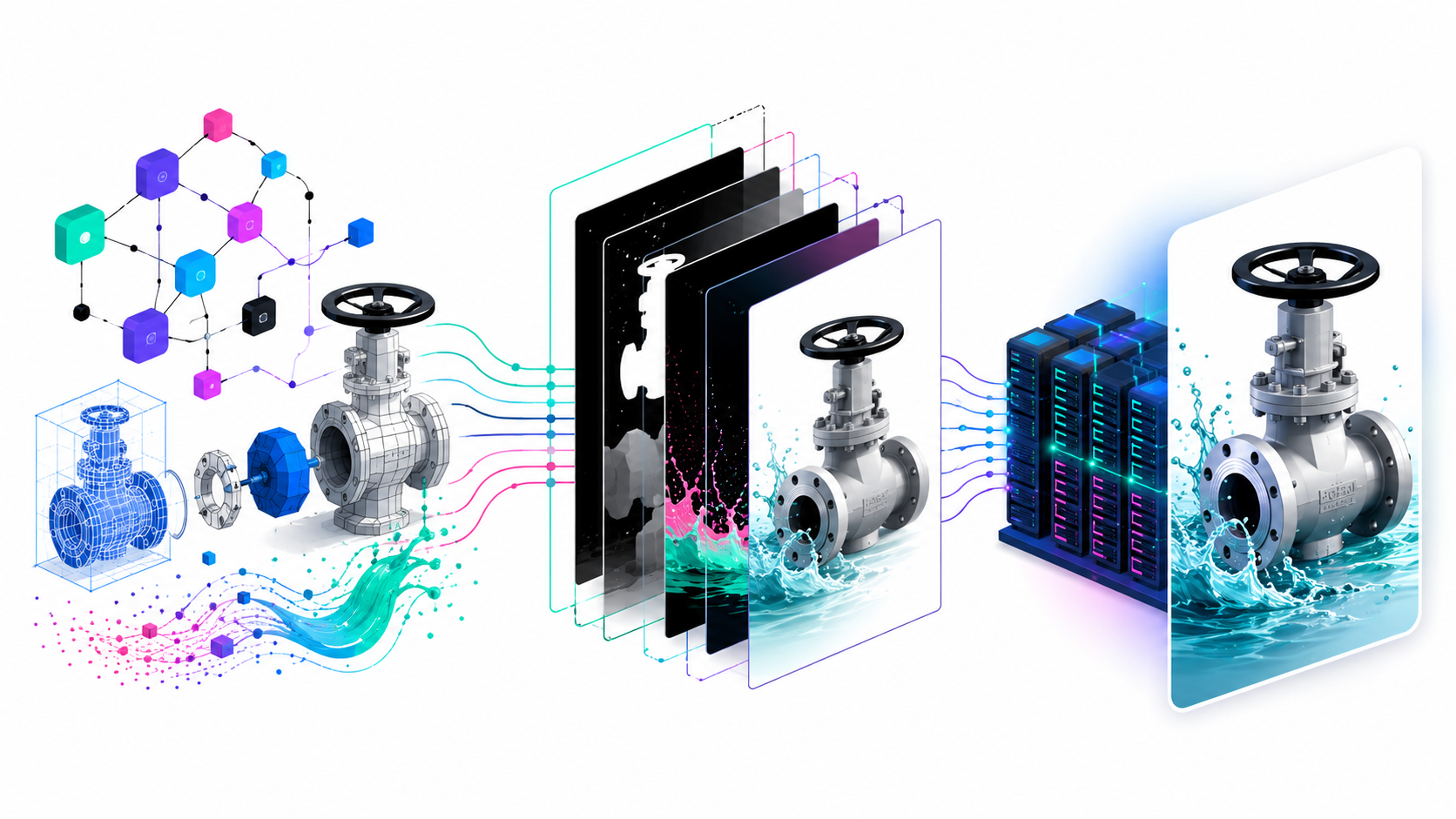
Most clients don’t ask about the pipeline. They ask about the result — and that’s reasonable. But the pipeline determines whether the result is possible in the first place, how long it takes and what happens when something needs to change in the last week before the trade show.
Here is how we think about it, and why the choices we’ve made matter for the work we deliver.
Why Houdini
Houdini is a procedural 3D application — meaning that every operation in the scene is a node in a graph, and the entire production history is non-destructive and re-editable at any point. For product visualization, this matters in two specific ways.
First, technical simulations. Fluid dynamics, particle systems, rigid body destruction, cloth and soft-body physics — these are Houdini’s core strength. When a product animation requires showing how a fluid flows through a valve, how components assemble under force, or how a surface coating behaves under stress, Houdini can simulate it physically accurately. Cinema 4D and Blender can approximate some of these. They cannot match Houdini’s simulation fidelity at production scale.
Second, parametric flexibility. When a client needs the same product animation in six colour variants, three sizes and two configurations — Houdini’s procedural structure means those variants are parameters, not separate projects. A change that would take three days to implement in a non-procedural pipeline takes three hours. At the brief stage this sounds like a minor efficiency. At the delivery stage, when the marketing director decides the hero colour is changing, it is the difference between a one-day fix and a rebuild.
Why Nuke for compositing
Nuke is the industry-standard compositing application for VFX and high-end commercial production. When CGI needs to integrate into live action footage — a product placed into a real environment, a technical simulation overlaid on location photography — Nuke’s node-based compositing gives us the control to match lighting, camera movement and colour science precisely.
After Effects is a capable motion graphics tool. It is not a compositing tool in the sense that matters for photorealistic CGI integration. The difference is visible in the result.
The render farm
We run our own render farm. This is not a detail — it is a production infrastructure decision that affects every project with heavy rendering requirements.
Outsourced render compute means queue time, upload/download bandwidth, and a dependency on a third party’s infrastructure during the most time-critical phase of any project — the final render push. Our farm runs overnight. When a complex scene needs twelve hours of compute, it runs while we sleep and the frames are ready in the morning. No queue. No bandwidth bottleneck. No third-party outage the night before the deadline.
For photorealistic product renders at 4K with physically accurate lighting and material properties, the difference between an in-house farm and a render service is typically one to three days in the final week of production. That is often the entire buffer between delivery and deadline.
What this means for your project
If your product visualization is a simple turntable on a white background, the pipeline choice matters less. Any competent 3D generalist with any tool can produce that.
If your visualization involves physical simulation, technical accuracy, photorealistic materials, integration with live footage, or the possibility of multiple variants — the pipeline is a production decision, not a preference. We built ours for exactly these requirements.
The first conversation about a new project is always about what the animation needs to show and what it needs to achieve. The pipeline question answers itself from there.