We use AI in production every day. Not as a demonstration of being current, and not because a client asked us to — because it makes specific parts of the production process faster, cheaper and in some cases better.
We also have clients who ask us to use AI for things it cannot currently do well, and clients who assume AI cannot do things it does extremely well. Both misunderstandings cost money. This is our honest account of where the line is in early 2026.
What AI does well in our workflow
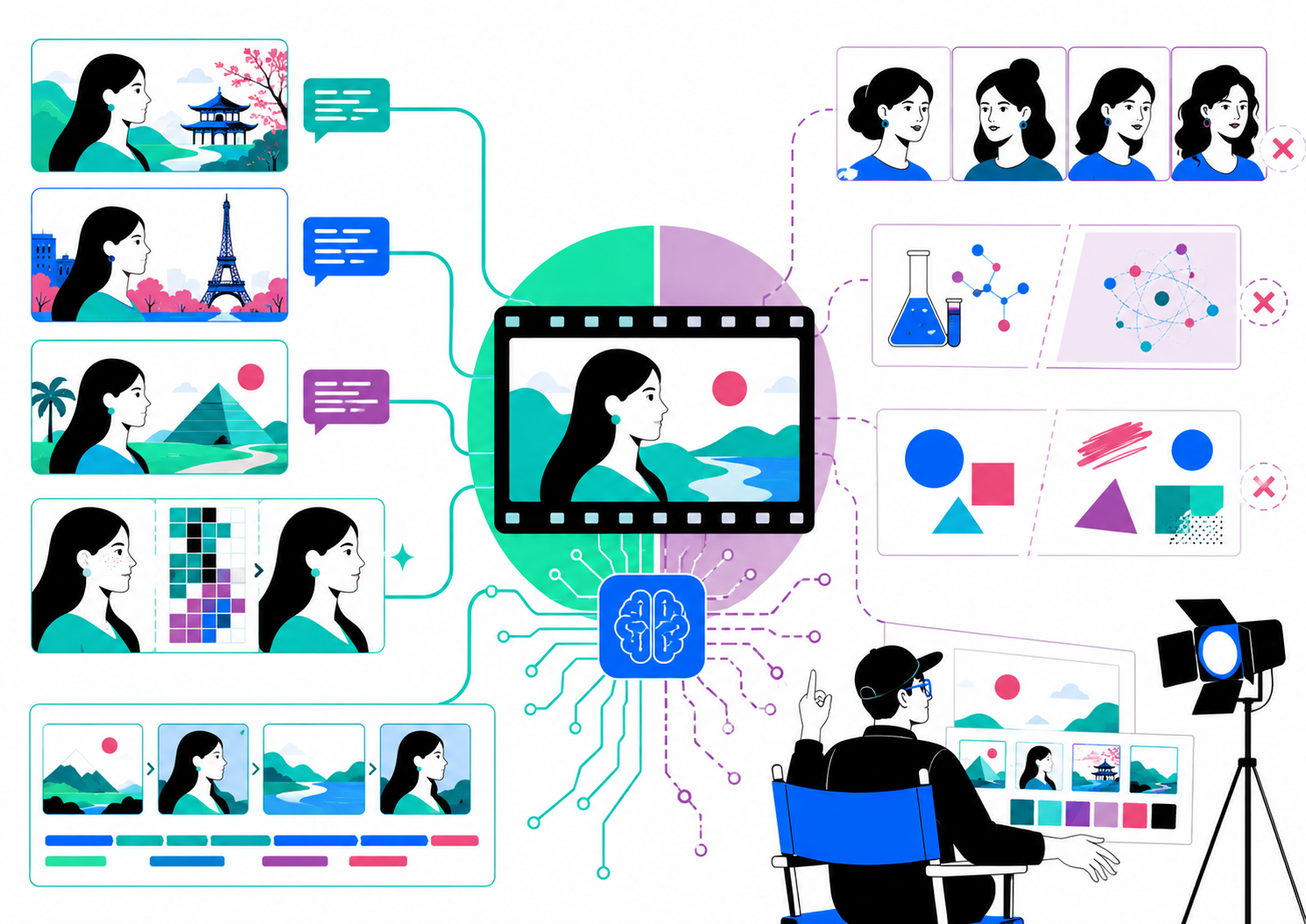
Multilingual versioning. This is the highest-value AI application in our pipeline. A master video produced in German can be adapted to English, French, Spanish, Italian, Polish and a dozen other languages using AI-assisted voiceover replacement, automated subtitle generation and on-screen text localisation. Each version is reviewed by a human. The total cost per additional language is a fraction of what a traditional dubbing and resync process costs. For clients running pan-European or global campaigns, this is transformative — not incremental.
Background generation and environment creation. For product shots, campaign imagery and visual composites, AI-generated backgrounds and environments have reached a quality level where they are production-usable for most applications. A product shot that previously required a location scout, a set build or expensive stock licensing can now be placed into a photorealistic environment generated from a brief. The quality ceiling is still below a dedicated location shoot for hero campaign material — but for secondary assets, social content and rapid iteration, it is more than sufficient.
Retouching and image adaptation at scale. Removing backgrounds, adapting product colours, resizing and reformatting large asset libraries — these are tasks where AI has almost entirely replaced manual labour in our workflow. What took a retoucher two days now takes two hours with human quality control.
Rough cut scripting and structure. For explainer films and corporate content, AI-assisted first-draft scripting is genuinely useful — not as a replacement for a writer, but as a first structure that a writer then rewrites. It is faster than starting from a blank page and surfaces structural options that a single writer might not consider.
What AI cannot currently do well
Consistent characters and faces across a production. AI image generation still struggles with character consistency across multiple frames and scenes. If your campaign requires a specific person, a recurring character or a brand mascot to appear consistently throughout a video, AI generation will not maintain that consistency reliably. This requires traditional character design, 3D modelling or live action footage.
Scientifically accurate visualisation. For life science and technical content, AI-generated imagery cannot be trusted to be accurate without extensive verification. A cell receptor shown in the wrong conformation looks right to a non-specialist but is wrong. AI generation optimises for visual plausibility, not scientific accuracy. For any content where accuracy is non-negotiable, AI assists the process but does not drive it.
Brand-specific visual language without custom training. Generic AI models produce generic results. If your campaign needs to look like your brand — specific colour relationships, specific typography treatment, specific compositional style — a generic model will approximate it badly. Brand-consistent AI output requires either custom-trained models or extensive human direction and iteration. We do both, but neither is “fast and cheap” in the way the AI hype suggests.
Replacing creative direction. AI is a production tool, not a creative director. The brief, the strategy, the narrative structure, the decision about what to show and what to leave out — these require human judgment that AI cannot currently replicate. The studios that treat AI as a replacement for creative thinking are producing content that looks like it was made by AI, which is currently a meaningful quality signal to viewers even if they cannot articulate why.
The honest summary
AI makes the adaptation and distribution layer of production dramatically more efficient. It does not yet make the creative and production layer significantly faster for high-quality output.
The studios claiming otherwise are usually showing you the best 5% of AI-generated frames, not the production output that required three hours of iteration to achieve.
We use AI where it genuinely helps. We do not use it where it doesn’t. That distinction is the work.