The call comes on a Thursday. The congress is in nine days. The regulatory submission was confirmed late. The brief exists but it hasn’t been approved internally. The creative agency is already at capacity. Can we help?
Yes. This is not an unusual situation for us. It is, in fact, the situation that Fast Track was built for.
Why most studios can’t do this
A standard production studio runs on a booked calendar. Projects are scheduled weeks or months in advance. The pipeline is full. A new urgent brief means either pushing an existing client or declining the new one. There is no slack in the system for the kind of deadline that appears on a Thursday for a congress the following weekend.
We built our intake process specifically to have that slack — not as an accident of being small, but as a deliberate production infrastructure decision. Fast Track is not an emergency premium service. It is how we work for a specific category of project.
What Fast Track actually involves
The first call happens within 24 hours of initial contact. The creative director is on that call — not an account manager, not a producer. The brief is assessed, the scope is defined and a realistic delivery timeline is agreed. If it cannot be done to the required standard in the available time, we say so on that call. We do not take a Fast Track brief and then ask for an extension three days before delivery.
The brief is tight. For Fast Track to work, we need the three things that matter: the communication objective, the source material and the approval chain. If any of these are missing, the clock starts when they arrive, not when the brief was sent.
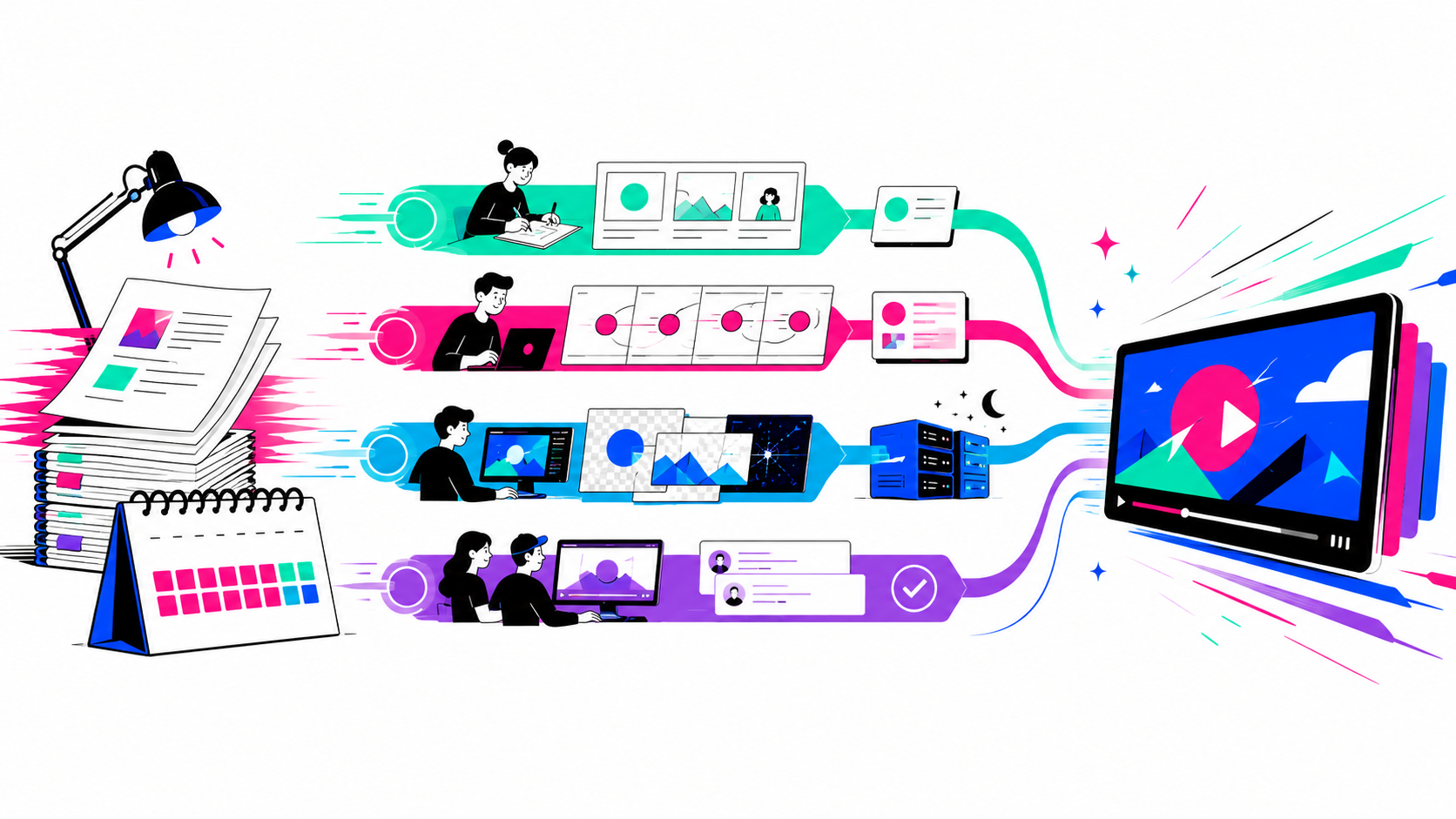
Production runs in parallel wherever possible. Script review and storyboard development happen simultaneously. Animation begins on approved sections before the full storyboard is locked. Render and compositing run overnight. This is only possible because the whole production chain is in-house — no hand-off points, no waiting for a third-party supplier.
What Fast Track is not
Fast Track is not lower quality. The same pipeline, the same people, the same review process — compressed into a shorter timeline. The compression works because of how the process is structured, not because any step is skipped.
Fast Track is not suitable for every type of production. A complex 3D product animation with photorealistic rendering requires compute time that cannot be compressed below a certain point. A multi-location live action shoot requires pre-production that cannot be done in 48 hours. Fast Track works best for animation-led, motion graphics and short-form content — formats where the production chain is entirely controllable and not dependent on physical logistics.
And Fast Track is not a last resort. Some clients use it as their primary workflow — not because they are disorganised, but because their business runs on a reactive calendar where the brief and the deadline arrive together. We built a process for that. It works.